Sustanon 250: Anatomy of a Four-Ester Blend
Why a 250 mg/mL Sustanon vial behaves like four compounds — propionate, phenylpropionate, isocaproate, decanoate, each with its own curve.
Sustanon 250: Anatomy of a Four-Ester Blend
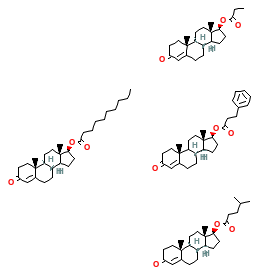
Sustanon 250 looks like a single product, but each millilitre is a designed mixture — four testosterone esters, four half-lives, four release curves summing into one profile. It’s the most instructive blend in the catalog for understanding ester kinetics.
The recipe
Each 250 mg/mL vial of Sustanon contains:
| Ester | Amount | Est. half-life | Role |
|---|---|---|---|
| Propionate | 30 mg | ≈ 2 days | Fast onset |
| Phenylpropionate | 60 mg | ≈ 4.5 days | Early coverage |
| Isocaproate | 60 mg | ≈ 8 days | Middle coverage |
| Decanoate | 100 mg | ≈ 15 days | Long tail |
The fast esters get levels up quickly after an injection; the decanoate keeps them from falling between doses. That combination is why Sustanon protocols typically dose every 3–7 days instead of chasing a single ester’s curve.
Why the blend matters for kinetics
A single ester has one exponential decay. A blend has four — and the sum doesn’t look like any of them. The ester half-life plotter shows exactly this: select Sustanon 250 and it draws each ester separately plus the combined total. The decanoate line barely moves while the propionate spikes and falls, and the total is smoother than either.
Clearance context
Because the decanoate component has a 15-day half-life, the blend’s tail behaves like a long ester: reaching the conventional 5% remaining threshold takes on the order of 9+ weeks after the last dose. The ester clearance calculator models this — but remember, clearance math is not a detection-window prediction.
Research context
Sustanon is a standard reference for multi-ester release-curve analysis and blend uniformity testing. See Sustanon 250 for CAS, purity and specifications.
For laboratory research use only. Not medical advice.
FAQ
Frequently asked questions
What exactly is inside Sustanon 250?
Each 250 mg/mL contains 30 mg testosterone propionate, 60 mg phenylpropionate, 60 mg isocaproate and 100 mg decanoate — four esters with half-lives from about 2 to 15 days.
Why blend four esters instead of using one?
The blend produces a composite release profile: the fast esters cover the first days while the decanoate carries the tail, flattening the curve between injections.
How do I model the blend?
Model each ester as its own first-order curve and sum them. The ester half-life plotter draws all four lines plus the combined total.
Keep reading
Related articles
Ester Half-Lives and Clearance: What Every Researcher Should Know
What an ester is, why half-life drives injection frequency, how first-order clearance works, and when a compound is effectively cleared.
All 11 Esters at a Glance: The Master Reference Table
Half-life, active fraction and clearance math for every ester in the Vyroval catalog — one table to bookmark, with links to the tools that model each one.
Bacteriostatic Water: The Solvent Behind Every Vial
What bacteriostatic water is, why the 0.9% benzyl alcohol matters, and how it fits into lyophilized compound reconstitution.
Laboratory tools
Put it into practice
From the catalog
Reference compounds
For laboratory research use only